Sunday, December 8, 2013

Days Drifting along in Thakhek

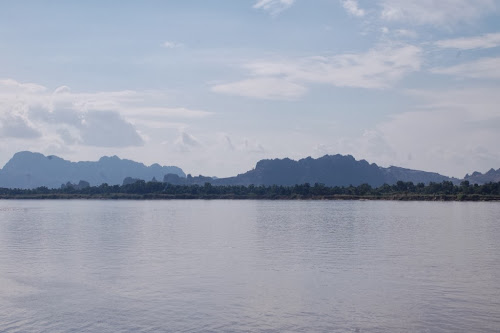
Today, I am writing from this relaxing climbing camp about 10 kilometers outside of Thakhek, Laos. This camp is about another 2 km off the main road, set in a natural mountain cul-de-sac ringed with limestone cliffs and mini-peaks. It is a stunning setting, as you can see from the below picture looking back to the camp from the main road. The cliff walls are so steep that the sun rises about 2 hours later and darkness sets in an hour before the sun retruns to the horizon at dusk. The camp has a mix of tents, dorms and bungalows - very glad that we opted for the latter since we are going to be here for a couple of weeks. After so much time traveling, we moved right in to our bungalow and sprawled/organized - perhaps practicing for when we have a proper home sometime down the road.

For those that might not know, a climbing camp is usually set up near some excellent rock climbing. My experience is that they tend to be run by Germans, for whatever reason. This means they are always run pretty well, which is important since they are self contained -- a resort for climbers. International climbers abound, with a mix of accents and languages reflecting the draw of exotic climbing. This particular camp, called Green Climbers Home, is run by a German couple that embarked on a round the world trip in 2010 and ended up posting up in this magical cul-de-sac. The climbing is literally on top of the camp, with walks to specific climbs as short as 15 seconds.

Right now, it looks like it will be several days, possibly as many as 13 or 14, before I ride in/on an internal combustion engine. This got me thinking about our travels and also our normal life in San Francisco. In both, it was exceedingly rare to go even one day without the use of a car, bus, subway, plane, tuk tuk, boat or truck. If we make it the full two weeks, this might be the longest period in my life. The only similar stretches that might be close are our 11 days on the John Muir Trail last year and my independent study way back when I studied abroad in the northeast of Brasil. For these two weeks, if we need to get someplace, it will be via our feet or rented bikes. With the short walks to the crag, and the lovely biking by rice fields and those cliffs, that is a nice situation for us.

It is wonderful to slow down. And, staying in one place is good for a couple of reasons: personal financial and climate costs. On the personal financial front, it is a pretty accurate rule of thumb to think of any time you are moving, either in the air, over the ground or across water - you paid for that pleasure. Movement = money. So, in stopping our movement for a couple of weeks, we can bank some cash. Always a good thing.

For climate, another general rule of thumb is that transport = carbon. All those modes of transport I mentioned above use petroleum. That is really what an internal combustion engine is, a device for transferring the energy from burning carbon based inputs to turn wheels or turbines. So, if we are not using any engines for a couple of weeks, we can ease off a little on our carbon debt. These travels have been amazing, but they have not been climate friendly. We have taken dozens of flights, which is the most carbon intensive mode of transport, and covered thousands and thousands of miles via buses and the overland truck through Africa. We have tried to be as low impact as possible, but the reality is that travel means covering distances and in 2013 that means negatively contributing to climate change.

Beyond those obvious and quantifiable impacts of our slow down, there is likely a third, more amorphous benefit. Staying in one place and getting to do something we both love almost daily, that has to be good for our mental and physical biorhythms. Daily life made of of eating well, climbing, running, yoga, reading and sleeping puts us in a good place to think, wihtout getting sidetracked by the daily grind of logsitics.

Our revealed preferences from this year have been movement, movement, movement. We love seeing new parts of the world and get restless a bit too easily. Now, with the carrot of excellent climbing, we are slowing it down.


Thursday, December 5, 2013

Fitness from the Road: Running in Ventiane, Laos

During these travels, we have run in a lot of country capitals and somewhat surprisingly, running in Ventiane has to be among the most pleasant. Other capital contenders of pleasant runs that we have had, include our own (D.C.), London, Vienna, and Tel Aviv. But most of our runs in other capitals across the globe have paled in comparison to Ventiane.


The thing about the pleasantness of running in Ventiane was not so much the scenery that we encountered, rather it was the calmness. Usually running in any give country's capital, or really any big city, entails fighting crowds, dogs (oh the wretched street dogs), hollering people, and trying not to inhale that 1963 truck's exhaust too deeply. 
In contrast to this chaos, Ventiane has created a lovely river walk that stretches for miles upon calm miles along the Mekong River. Even better, the river walk is more like three river walks. One river walk is a pleasant paved traditional walk about 15 feet above the river. The second river walk is a wide dirt path down in the river bed close to the river and perfect for running. The third river walk occurs at dusk when the road along the traditional promenade is closed to traffic and Laotian exercisers with rollerblades, bikes, and of course, running shoes abound. This third river walk is delightful for the company as well as the fact that it accompanies an amazing sunset over the river.

The Ventiane running happiness comes at an auspicious moment, as I have just decided to try to run a fast (for me) 10k at the beginning of February. I have 10 weeks to train. My training schedule tries to incorporate the things that I have heard are best for getting faster for this race: threshold training, plyometrics, and a weekly endurance run. I will attempt to do all this while also trying my best not to injure myself.
The focus on being injury free means that I have to be careful about mileage. For the past year, I estimate that I've averaged only 15-25 miles running per week. It is a low number but if you add walking and hiking, then there are some weeks when I have gotten north of 100 total miles. That said, running is a different animal and thus the hesitancy about too large a mileage increase. So my 10 week training plan increases the mileage in intervals and gradually:
  • Week 1: 23 miles
  • Week 2: 25
  • Week 3: 23.5
  • Week 4: 25
  • Week 5: 27.5
  • Week 6: 25.5
  • Week 7: 28
  • Week 8: 24
  • Week 9: 22
  • Week 10: 16
Week 10 is a low mileage week to minimize the injury risk and hopefully allow a big push on the day of the 10K. Pulling off this training will be tricky in the middle of our traveling motion as I have blogged about before.  But so far in Asia, it seems doable -- especially in places like Ventiane.

Friday, November 29, 2013

A Day in the Life: Moving through Myanmar

Today started a little rough. Muriel and I caught a night bus from Bagan back down to the capital, Yangon. The bus was comfortable enough, and like most night buses it stopped a couple of times for pit stops and for people to shovel in some food. Thankfully, it was not too cold with AC blasting and mostly quiet. By now, I have a system for the night buses that involves a beloved playlist on my phone, an eye mask to block out the disorienting lights, and a hoodie to stay warm and comfy. Not a great night of sleep, but plenty good enough.

We arrived at about 5 am to my least favorite place in all of Myanmar, the Yangon bus station. I viscerally hate touts and this bus station is lousy with them. 'Where you go?' 'Taxi?' 'Where you go?' 'Taxi?' It is so hard to know if people actually want to help you or see you as a big wallet. Easily one of my least favorite parts of travel.

Thankfully, we planned this out so that our next bus leaves in a little over an hour. No need for any help, this time. We wander/stumble around the awakening and sprawling bus station, until we find Winn Bus company that will take us close to our destination, the town of Kinpun. We had picked out this smallish town because of its proximity to a very important pilgrimage site, the Golden Rock pagoda that sits at the top of a roughly 1,100 meter mountain and draws pilgrims from across the country.

Back at the bus station, we have an hour or so to kill and pick out one of the many tea houses that are so common here. Muriel gets a Myanmar tea, which is tea with condensed milk to sweeten it up and I go with boring Chinese tea. We take a deep breadth, and then I notice some movement behind Muriel. Ugggh, a very big mouse is a couple of feet from my wife. We won't be lingering here very long. A minute later, I see a pretty big roach skittering about and it is time to move on.

The sun has slowly risen and the day is starting in earnest. Even though I could feel more rested, there is something so calming about the beginning of a day. It is not that common for me to see the light of dawn back in our old professional life, as I am more of a night person. But still, it always seems to strike something deep in my biorhythms and feels good.

We get on the bus and doze a bit, in several hours we are off the DC-9 equivalent bus and on to the open bed of larger pickup truck for the 45 minutes to Kinpun. We pull into the guest house about noon, both feeling pretty energetic and good. Our original plan was to relax today, read and do some stuff online, but we made pretty good time and there is plenty of daylight to tackle the 1,000 meters and 7.5 miles of the pilgrim route up the mountain to the golden rock.

We start out and the trail is pretty easy to follow. There are hundreds of stands selling water, food and snacks. Still, it is very pleasant and more shade-covered than I had anticipated. Still, the humidity is pretty intense and it is not too long before both Mu and I are drenched in sweat -- so much sweat that you could wring it from our clothes. Only 6 more miles to go!

Nearly everyone along the way happily extolls us with 'Ming guh la ba!' - hello in Burmese. Mu responds in kind, while my attempts to reciprocate all feel bloated and wrong. We play with some of the kids on the trail, which is fun. After a couple of hours, we make it on a ridge and have vistas of the receding ridges that cascade to the east towards Thailand. On the other side, the flat expanse of Burma extends all the way to the horizon.

Eventually we make it to the pagoda way up at the top of the mountain. After the relative peacefulness of the afternoon on the trail, it is a shock to the system to have the thousands of people up here. Some rich tourist are being transported around by 4 porters while reclining colonial style, which makes me sick to the stomach.

We head to the golden rock, which is perched precariously on the mountain top and is coated in actual gold. There are many pilgrims around, which is cool to see. Especially the groups of youthful monks in training, some with smartphones which has become a bit disarming to me and quite common. Still, we get a bad taste in our mouth once the prime spots of the pagoda are reserved exclusively for men, as mu wrote about so well here.

It is starting to get dark and we pile in with about 50 other people in the back of a beat up truck that will wind its way down the mountain. It is proper night by the time we get down all the way down, with several breaks to wait for trucks coming the other way up the road.

Then, we have a wonderful dinner in a restaurant a few stalls down from the hotel. Burmese curry and soup and rice and some fried greens. All delicious and costing about $2 bucks. Followed by a scoop of ice cream on the street. A great finale to our full day. Then it is back to the hotel, I read and mu does some stuff on our ipad.

This was one of the times where the journey was far superior to the final destination, an experience that has occurred many times this last year+. We go to bed having enjoyed this day and ready for the next one.


Wednesday, November 27, 2013

Bagan: 3000 Buddhist Temples, Pagodas, Monasteries and Ruins

After taking a night bus from Myanmar's economic capital, Yangon, we arrived to Bagan in the dark. 5 am dark. We stumbled out of the bus into a tea cafe that is typical of Myanmar --outdoors, free oolong tea always available and child size plastic furniture -- brightly colored stools surrounding a one foot tall table. We ordered sweet tea to drink before the oolong tea and waited for the sun to arrive. As we waited, we could hear the singing and preaching of a nearby Buddhist pagoda.

80-90% of Myanmar's population are Theravada Buddhists. Buddhism is a religion that I have always admired because of its realism and its hope. I often refer to Buddhism's realism -- its first noble truth that "Life is Suffering." I find this noble truth comforting because it reminds me to be grateful for the many moments that are not suffering. I also admire Buddhism's focus on creating a "skilled mind" --that if your mind is skillful then you have the power to avoid cause suffering or remorse. A life to aspire to.

But in Myanmar, I have read and seen aspects of how this state-sponsored religion has been harmful. For example, riots have erupted in Myanmar within the last year that have displaced 150,000 Muslims. In fact, in one day 70 Burmese Muslims were murdered after government officials took away the sticks that they were trying to defend themselves with. The victims of this massacre and much of the violence is directed at an ethnic minority called the Rohynga. The Rohynga have been systematically discriminated against, including a 1982 law that denies them Myanmar citizenship unless they can prove that their family lived in Myanmar prior to its independence in 1948. Another aspect of this state-sponsored religion that is troubling is the misogyny. The misogyny feels less prevalent than in the other major world religions but I am still bothered when I see signs like the below:

Apparently, there are different schools of thought in Buddhism about women's role. Some people believe that being a woman is equivalent to being an elephant or some other noble beast and that you have to be reincarnated as a man before you can be enlightened. Others believe that women can attain enlightenment in their current state. I'll take the latter.

I don't think that Buddhism is the direct cause of the terrible violence or the misogyny but it is really sad to see the affiliation between them. Especially because Bagan is such a special place. Bagan has more than 3000 temples, pagodas, and other Buddhist religious places within a 10 or 20 mile radius. These religious places are living, old, and impressive. People still worship at them. They were built centuries, and in some cases a millennia, ago. And they are filled with huge buddhas and intricate painting and sculpture. The stature of the buildings themselves is impressive and looking out on their different forms and colors while the sun is setting is a mesmeric experience.

The temples, pagodas, and holy places remind the visitor of the long-suffering, enlightenment, and teachings of the Buddha. I particularly respect the five precepts of the moral code of Buddhism: "not to take the life of anything living, not to take anything not freely given, to abstain from sexual misconduct and sensual overindulgence, to refrain from untrue speech, and to avoid intoxication, that is, losing mindfulness". The moral code is not absolutist like the 10 commandments of Christianity-- instead, it is a guide that directs people to live their best lives.

There is much to esteem about Buddhism and that makes it only sadder to reflect on how, like other major religions -- especially state sponsored religions -- it can be associated with violence


Thursday, November 21, 2013

Crossing the mountains into Myanmar (Burma)

Yesterday, we crossed the Thai/Myanmar border at Mae Sot-Myawaddy, and will be here in Myanmar for the next 8 or so days. The country has been of interest to me for years, since I had a bit of an Orwellian fling back in high school and read in great detail Orwell's account of his time stationed in the then-British colony, a gem of a little book called Burmese Days. Back then, and for me, this country is called Burma, and not Myanmar - the name given to the country by the military-led juntas. We learned yesterday that this name was actually a re-appropriation of the ancient kingdom that thrived here centuries ago, and that Burma was the colonial name for this region.

The last 70 odd years have not been very kind to this country, resulting in an eroding of the embodied wealth that had this part of South East Asia riding high as a proud, conquering force. During WWII, this area was the site of horrific fighting between the Japanese, the British and nationalists, with hundreds of thousand dying in the conflicts. The country gained independence after WWII and then fell quickly under military rule, which continued for most of the last 60 years. It has only recently been holistically open to foreigners, and this opening process is far from comprehensive. There are still parts of the country that are effectively closed to foreigners and you get the sense of a State apparatus watching your movements in the country.


Knowing these issues, I was still very excited to come to here, having read up on the beauty of the landscape and the kindness of the people. It has been touted as a travel destination that is a little (or a lot) less tainted by the destructive powers of impermanence, anonymity and money that so often accompany high volume travel spots. Also, we happened to live pretty close to a famous restaurant in San Francisco, called Burma Superstar, so I was relatively well versed with the excellent cuisine.

Back to yesterday, when we crossed the border. Both of our travel radars were on full alert, I think because we have heard about the challenges of traveling in this country. It is only within the past year that western foreigners have been allowed to cross into Myanmar via land and travel throughout the country. Also, our friends had told us about their travails trying to convert dollars to Kyat, and the scrutiny each dollar was afforded before being accepted or rejected. With an acceptance rate of about 50%. We heard this cautionary tale when we had exactly zero dollars in our possession and then had to cobble together several hundred dollars in hard currency from the appropriate years and series, so we could convert when we arrived. FInally, getting our visas had been a bit of a challenge in Bangkok, so we were on edge a bit crossing this border by foot.

Our fears could not have been more further afield from the reality we had crossing. The crowded border station had the vibe of Cheers, not an authoritarian regime. We have never met friendlier border officials. Each official we spoke with and who did the various aspects of the crossing was so excited that we were coming into their country, from taking our pictures, to verifying our customs declaration, to providing us with a handy map, to explaining how to get from the border to the most integrated national transportation network, to filling out our entry paperwork. Muriel is wonderful with trying to learn a bit of the languages in our various destinations and this is a great ice breaker, so she was asking how to say various phrases. One official told her that she would be quizzed upon her return to make sure she had learned some of the language, which got a big chuckle from everyone.

Once we changed dollars painlessly, we got a shared taxi for the 5 hour trip to the larger city where we would catch a bus to the capital, Yangon. We got lucky, as we arrived in Burma on an odd numbered day when traffic through the mountain pass was flowing our direction. You see, the road is very rough and narrow so traffic only goes one direction each day. We had missed all the buses, so a shared taxi was our only option.

We got our taxi, had our bulky backpacks strapped to the roof and were off in a few minutes. The road soon got rougher, slowing the pace but giving more time for the expansive views of the countryside as we gained elevation. The ridge we were climbing was probably a thousand meters tall, a good way up and up. Every couple of kilometers, there would be a monastery on the side of the mountain, usually with people fundraising for its upkeep.

Eventually, we crossed over the apex of the pass and before us lay a vast expanse of this country. Below us to the horizon was the lowland contrast to the tall ridge we had been crossing. A handful of jagged rock towers are seemingly sprinkled at random throughout this otherwise flat expanse. It is a long way back down to the valley and I spend most of the time looking out the window, thinking of this country that was private and closed off for so long. It feels like we have crossed the physical barrier that guarded the country to the east and can now begin exploring in earnest.

Later that night, we arrive in Hpa'an with no idea of where to stay. Our shared taxi driver takes us to various guesthouses and makes sure that we are comfortable. His hospitality is admirable but when he refuses to take our tip for his extra effort, we are blown away. He simply took care of us out of the goodness of his heart and refuses a 20% tip on the fare. This magnanimity astounds us because, globally, taxi drivers always seems to be out to make extra money. But more than that, we knew that he was just scraping by -- in an earlier conversation we learned that he had worked everyday for the past 3 months shuttling goods and people back and forth, heading east and west as dictated by the direction of traffic over the mountain pass. His constant work schedule meant that he had not seen his two children for these past three months as well.

This morning, we ran in rice fields by the Hpa'an main pagoda. It was very peaceful, with the same jagged karst peaks rising from the flat valley floor and along river banks large and small. I felt the power of this place and its beauty for the first time at the most personal level, from my own two feet. The care of the farmers is evident, even as we trundle along, with recycled fishing nets protecting vegetable plots and baby rice plants just starting to take hold after being planted individually by the river's edge. We eventually ran into a field of tomatoes, ground nuts and gourds with a petite farmer, and fell into a conversation.

The farmer turned out to be a youthful 66 years old, exactly double my own 33 years on earth. He spoke in halting and proud english, with long pauses between words as he racked his brain for the right word. We were so impressed with his language skills, and talked about his life as a teacher who lost his position and came to be a farmer. He sketched out his plot of land and told of his pride in coaxing so much from the sandy river bed. He spoke touchingly of his pleasure in getting to meet us - "congratulations, I am so happy to have met you." Such a powerful, simple declaration and one we reciprocate in full.


Monday, November 18, 2013

Variety in and around Chiang Mai: Climbing, Cooking, and Teeth Cleaning


We've had a busy six days in and around Chiang Mai -- some learning, personal maintenance, and soreness inducing exercise. In Chiang Mai, we learned some easier Thai recipes when we took an 8-hour cooking class with Wilson's dad. We also got our teeth cleaned and I got a Thai massage (or two). And thenafter Wilson's dad flew out of Thailand back to the US, we headed to climb at "Crazy Horse Buttress". (Crazy Horse Buttress, a very American sounding name, was unsurprisingly accidentally named by an American.)
Learning to Cook Thai Food

Fun, fun, fun to stand in front of your own wok and use a metal spatula/ to measure 2 teaspoons of fish sauce and 3 spoons of oyster sauce and then with a little help of some fresh garden ingredients create Pad Thai. In fact, the whole cooking class with the Scenic Thai Cooking company owned by an avid Thai female traveler was a very enjoyable experience.

At the beginning of our cooking class, we went to the market to understand Thai ingredients. After that we drove to a farmhouse/garden with an open air kitchen that had at least 20 cooking stations. We walked around the garden identifying 3 different kinds of basil (sweet, hot, and lemon) and eating long beans off the vine. After that we got to cook (and eat) five different dishes of our own choosing. I chose Pad Thai, Papaya Salad, Tom Yum Soup, Panang Curry, and Mango with Sticky Rice. Yum. After we left the cooking class, none of us ate the rest of the day.

Personal Care and Maintenance

Our "Korol dream" has been less of a dream for our teeth. Our calamity insurance doesn't cover dental care and thus our pearly whites have become a little less than pearly. So we decided to do a little medical tourism and get our teeth cleaned. It was a little scary because I wondered if the sterilization standards are as good as the US but then I saw the fresh clean office, new equipment, free wifi and dentists and hygenists with hygenic masks and I felt much better about the endeavor. I felt really good about the endeavor 30 minutes later and only $25 poorer after the Thai dentist had scraped the plaque off my teeth and polished these pearlies.

Climbing at Crazy Horse

The climbing around Chiang Mai is actually 35 km away from the city. And you can get there one of three ways: (1) take a shuttle with the local climbing company; (2) rent a motor bike; or (3) point to the place on a map and ask a bunch of Thai people how you get there. We went with option 3. It took us a little longer but it was much cheaper than options 1 and 2. It is not a very efficient way to go, however, so we ended up staying 3 nights right by Crazy Horse (the "crag") instead of going back and forth to Chiang Mai like most climbers do.

We really enjoyed staying right by the crag. Not only was it very peaceful (except for a lot of festival fireworks), walking through the tiny town at the crag's base was a relaxing moment before and after the induced adrenaline and physical punishment that accompanied rock climbing at Crazy Horse. And the place where we stayed there in the countryside by the crag, La Bhu Saleh, was a magical place built in Thai style, decorated with original art work, and owned and operated by sweet and gentle Thai people. We loved it.

Chiang Mai and its environs treated us well and am sad to leave. But I am sure Myanmar (Burma) will be another new and interesting adventure. Onward.


Saturday, November 16, 2013

A Market Culture: from papaya salads to knock off iPads

Today was the first of eleven days in Thailand that I did not stroll through a market. My dad, who was with us for a week here in Thailand said that combined between Nepal and here he had spent more time 'shopping' than the last five years combined, or maybe even ten years. He hates shopping.


We do seem to spend more time than I had anticipated in markets, but that is where the action is taking place, the spots for the best street food and epicenters of people watching. So we have joined the crowds and wandered through markets big and small, during the day and at night. The food in the markets has been such high quality, better than my previous two trips to this country. It has gotten to the point where i am disappointed if we end up having a meal in an actual restaurant, as the food never seems quite as good and it costs at least 2-3x times more. Give me the stalls, the better food and some more excitement every time.


My favorite thus far was the night market in Chiang Rai that takes place on Saturday nights. 4 blocks were closed to traffic and two rows of stalls were set up selling all sorts of food and cool twists on the more conventional stuff you see at the other markets. There were several thousand people strolling up and down the market, which had a strict clockwise walking rule up one side and down the other to keep things moving along. Only a few of the many thousand were tourists, and this made it all the better because it was not the same old t-shirts, linen travel pants and knickknacks.

A close second to this market in my hierarchy was the Chatuchak market in northern Bangkok, which takes place during the day on Saturday and Sunday. This is a sprawling place, with seemingly hundreds and hundreds of stalls, cordoned off to specific types of durable goods and food. The mix of people here was more mixed between travelers and Thais, which was fine. The thing that really impressed me at this market was how cool some the stuff was for sale. There were dozens and dozens of these little boutique stalls that were as spiffed up as many stores on Chestnut street in the Marina district of San Francisco or the West Village in NYC. Most of these tonier stalls were selling clothes, and I came away wishing that I had just packed an empty backpack and filled out my wardrobe for the next 3 months, and beyond, from here. Next time.

Beyond the enjoyment of wandering these markets, I have also been thinking about the culture of knockoffs. They are everywhere. I define knockoffs as fake goods, such as dress shirts or backpacks, that have global brand labels and are made to look as close as possible to the authentic product. They usually cost many orders of magnitude less and have a lower quality. Part of the bargain for the buyer is knowing that fake is going to fall apart before a genuine article.


Sometimes, i am a big fan of knockoffs. Throughout our travels, this year and farther back, I have availed myself of at least a dozen fake Ray-Ban sunglasses, never being willing to pony up for the real ones due to concern about loss or breakage. However, I now have a pair of real Ray-Ban prescription sunglasses that have been worn pretty aggressively for almost 2 years and have clearly outperformed the fakes that fell apart or stopped fitting. With these sunglasses you do get what you pay for, despite what I have thought for years.

I remember when Mu and I were living in Saigon, Viet Nam several years ago and had bought a ton of stuff to bring back home. We went looking for backpacks that we could stuff and bring the bounty home, going from stall to stall in the major city market. I was studying the fake Northface, Lowe Alpine and all the other outdoor brands pretty close - looking at the stitching and testing out the zippers to be sure that they would survive the trip home. At one stall, the owner came up and saw how close i was assessing his merchandise. After a minute he came over close to me and looked very apologetic - "i am sorry mister, these are not real." No kidding! But, still I loved his honesty and sales approach and we might even have bought his knockoffs instead of the others who were so adamant about their genuineness.


As we have been bumming around Bangkok and northern thailand I keep thinking about the knockoff culture that permeates. Is that girl's Gucci bag real? Probably not. What about that guy's Nikes? Perhaps? What about that seemingly fancy watch, maybe a Rolex? Or the iPads we see people using everywhere?

I emailed a few friends that work at Apple for their thoughts about the fake apple devices that are pretty common in this part of the world. For example, some of the ipads you see on the street are suspiciously thick. They wrote back the following;

- It's difficult to tell without seeing them if they are real or fake. We've seen a load of fake ones through Asia. They get close, but when you look closely, you can tell how badly made they are. They've started using Android software and just making it look like iOS. But again without seeing it, it's difficult to know for sure. If you start asking too many questions they get a little shifty

- From the manufacturing side, we make huge investments in effort, processes, and equipment to get the parts to look and fit together just right, so the forgeries look awful.

All this gets to my larger point, that once there are a few (or many more than that) fakes around, you start to question just about everything. Those Adidas bags at the market that i like, they can't possibly be real. Those electronics, how can you trust them? Which seems fine if all you expect to buy is the knockoff, but once you start thinking about getting the real one, with all the investment in manufacturing, quality and support, you just can't be sure. So the knockoff culture lets all of us buy cheap stuff that looks real, but caveat emptor if you want to step up. You just can't be sure you are getting what you are paying the premium.

I guess we will just keep perusing the markets, looking for cool stuff that we won't expect to last very long. Not the greatest sustainability strategy but the only one I can justify in this part of the world.